


Checking the implant
The dentist assesses the degree of integration between the implant and the jawbone, as well as the condition of the surrounding soft tissue

X

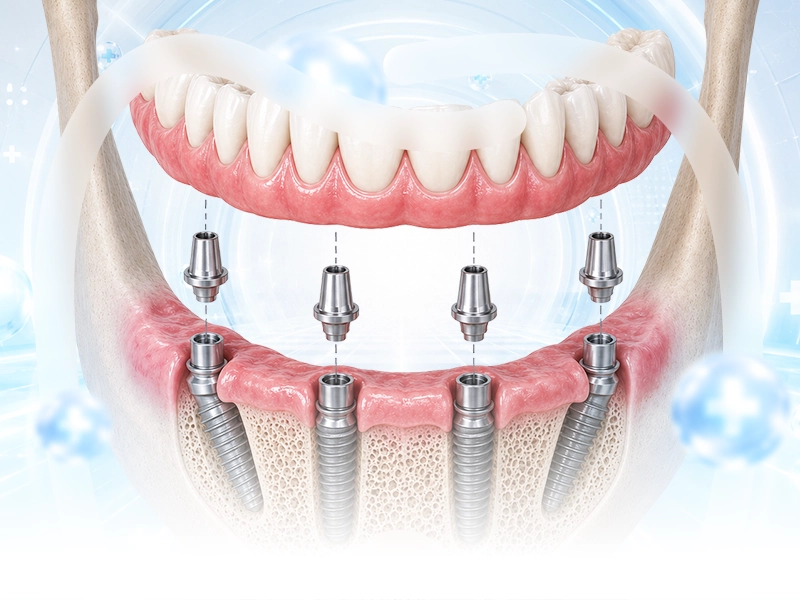
A restoration on an implant refers to a crown, a bridge, or a full-arch restoration that is connected to an implant post in order to restore both chewing function and aesthetics. Book an examination so that the dentist can advise you on the option that best suits your case.
 1 to 2 weeks

May be considered suitable when
 The tissue surrounding the implant post is healthyThe position of the implant post is well suited to receiving a restoration
Requires a thorough examination and careful assessment when
 There is inflammation around the implant postThe implant post has become looseThe patient's bite has not yet stabilized
Restorations on implants
 Single restoration: a Zirconia crown or a Cercon HT crown
All-on-4: a cast titanium framework with American acrylic teeth; or a hybrid restoration using a titanium or Co-Cr framework combined with Zirconia
All-on-6: either a hybrid configuration or a titanium configuration
Single restoration: a Zirconia crown or a Cercon HT crown
All-on-4: a cast titanium framework with American acrylic teeth; or a hybrid restoration using a titanium or Co-Cr framework combined with Zirconia
All-on-6: either a hybrid configuration or a titanium configuration

Infection control
An intraoral scanner and CAD/CAM technology are used to support the design and fabrication process, while an X-ray system supports examination whenever this is needed
Reusable instruments are collected and processed following a strict one-way workflow that includes cleaning, packaging, sterilization, and storage in accordance with proper standards before being brought into use for a treatment case. The surfaces of the treatment chair and any other contact areas are cleaned and disinfected between each patient visit. Single-use supplies are also replaced with fresh items for every individual treatment case
The dentist assesses the degree of integration between the implant and the jawbone, as well as the condition of the surrounding soft tissue

The exact position of the implant is recorded, either through a traditional impression or through a digital scan

The dentist designs a framework along with a crown or bridge that is well suited to the case

The dentist checks the fit, the bite, and the aesthetic appearance

The crown or bridge is permanently fixed onto the implant

The dentist provides hygiene guidance and schedules a follow-up appointment
Clean the area underneath the restoration using an interdental brush, specialized dental floss, or a water flosser, following the guidance provided
Do not bite down on or chew objects that are too hard, in order to help prevent the restoration from cracking or chipping. Contact the dental clinic if you notice any unusual sounds or if the restoration feels loose or uncomfortable
Contact the dental clinic if the restoration shows any signs of cracking, looseness, or discomfort. Any inspection or tightening of the screw must be carried out by the dentist, and only when indicated

The warranty policy covering the restoration is applied separately from the warranty covering the implant post itself. Conditions such as wear of the acrylic teeth, chipping of the porcelain, a loose screw, or inflammation around the implant may arise from a variety of different causes, and these need to be assessed before the scope of the warranty can be determined.
Patients should keep their records, receipts, and warranty card if one has been provided, and should also attend follow-up visits according to their scheduled appointments, so that the dentist can monitor their condition and address any unusual signs as early as possible. The warranty policy is applied in accordance with current regulations and the specific conditions attached to each individual service or material.
Warranty


