

Implant placement requires a genuinely high degree of precision in every single step of the procedure, in order to ensure that the position of the implant post is properly suited to the underlying structure of the jawbone as well as to the overall treatment plan that has been established. For this very reason, implant navigation systems were developed as a technology specifically designed to help the dentist plan the procedure ahead of time and to closely track the surgical process itself in real time. In order to help you understand this particular system more clearly, let’s explore it in detail together with Shark Dental Clinic in the article below.
What is an implant navigation system?
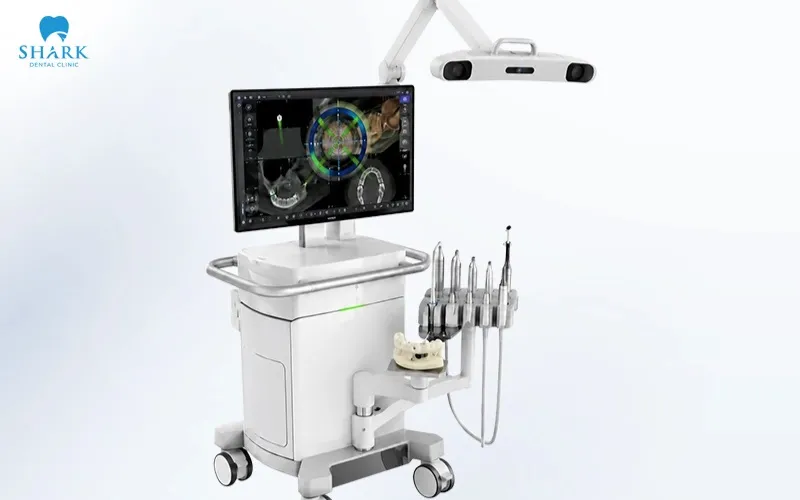
An implant navigation system is a technology that helps guide the dentist throughout the entire process of establishing the exact implant site and carefully placing the implant post into the jawbone. The system makes use of data collected from a Cone Beam CT scan in order to build a comprehensive treatment plan in the form of a detailed three-dimensional model. During the surgical procedure itself, the system continuously tracks the position of the surgical instrument and displays the relationship between the drill and the plan that had already been established beforehand, thereby helping the dentist carry out the procedure precisely in line with the intended treatment direction.
In other words, this particular system can be understood as a kind of guidance system that provides support to the dentist throughout the implant placement procedure, rather than a system that carries out the surgery entirely on its own. The dentist remains the one who directly operates the surgical instrument and makes all of the necessary professional decisions throughout the entire course of the procedure.
How an implant navigation system works
An implant navigation system operates by combining together a number of different sources of data, in order to provide meaningful support to the dentist throughout the surgical procedure. More specifically, the system typically brings together the following types of data:
- Anatomical data that has been collected from a Cone Beam CT scan.
- The planned implant position, which has been carefully established using specialized software.
- Tracking data that continuously monitors the movement of both the surgical instrument and the patient’s jaw throughout the entire course of the procedure.
Once the data registration step has been fully completed, the system will go on to display detailed information such as the entry point, the drilling direction, the angle of inclination, the depth, and the overall relationship to the previously planned implant position, thereby allowing the dentist to closely monitor and carry out the procedure accordingly.
How does an implant navigation system support the dentist?
An implant navigation system provides support to the dentist across multiple distinct stages of the overall treatment process, extending all the way from the initial planning stage through to the surgical procedure itself. More specifically, this particular technology is capable of the following:
- Supporting the development of a detailed three-dimensional treatment plan based on the specific location of the missing tooth, the available volume of bone, and any related anatomical structures that may need to be taken into account.
- Continuously tracking both the position and the direction of movement of the drill throughout the entire course of the procedure.
- Providing the dentist with the information needed in order to compare the actual depth of the drill against the plan that has already been carefully established in advance.
- Allowing the dentist to directly and continuously observe the treatment area, and to adjust the procedure whenever the actual clinical conditions present require it.
Applications of implant navigation systems in dentistry
Depending on the specific clinical case involved, the dentist may choose to consider using an implant navigation system in order to provide additional support during the implant placement procedure. This particular technology is typically applied in the following types of cases:
- Placement of a single implant, or of multiple implants at once.
- Full-arch implant placement procedures.
- Areas of the jawbone where the available space is considered to be limited.
- Cases that require especially careful control over the precise direction in which the implant post is placed.
- Positions located close to sensitive anatomical structures that require particular caution and attention.
- Cases that require especially close coordination between the restoration plan and the corresponding surgical plan.
That said, it’s worth noting that not every single implant placement case necessarily requires the use of a dedicated navigation system. The ultimate decision of whether or not to apply this particular technology is made by the dentist, based on the specific condition of the patient in question as well as the broader overall treatment plan involved.
The process of applying an implant navigation system
In order to provide support throughout the implant placement procedure, a navigation system is generally applied according to a structured process made up of several distinct steps, extending from the initial collection of data all the way through to the completion of the surgical procedure itself. Specifically, these steps are as follows:
- Step 1 – General examination and health assessment: The dentist carefully examines the overall condition of the patient’s teeth and gums, along with their broader general health, before proceeding to plan out the treatment in detail.
- Step 2 – Cone Beam CT scan: Detailed data is collected regarding the structure of the jawbone, as well as any related anatomical areas that may be relevant to the procedure.
- Step 3 – Collection of additional oral data: Any further data required by the system is carefully recorded in order to properly support the overall treatment planning process.
- Step 4 – Implant treatment planning: The precise position, direction, size, and depth of the implant post are all carefully determined using specialized planning software.
- Step 5 – Data registration and instrument calibration: The relevant data is synchronized, and the entire system is carefully calibrated before the surgical procedure is actually allowed to begin.
- Step 6 – Navigation-assisted surgery: The dentist carries out the implant placement procedure itself with the ongoing support of the navigation system throughout.
- Step 7 – Post-placement evaluation: The final position of the implant, along with its initial stability, is carefully assessed once the placement procedure has been fully completed.
Notable features of implant navigation systems
Implant navigation systems were developed specifically in order to provide meaningful support to the dentist throughout both the planning and the actual execution of the surgical procedure. Some of the most notable features offered by this particular technology include the following:
- Continuously displaying the direction, position, and depth of the surgical instrument throughout the entire course of the procedure.
- Helping to translate a digitally based treatment plan directly and accurately into the actual surgical procedure itself.
- Providing real-time positioning data that allows the dentist to closely and continuously monitor progress throughout the implant placement procedure.
- Allowing the overall treatment plan to be adjusted whenever the actual clinical conditions present happen to change during the course of the procedure.
- Supporting the long-term storage of treatment data, which makes it considerably more convenient to track and cross-reference treatment records over time.
Conditions and limitations of navigation systems
Although a navigation system does help provide meaningful support to the dentist throughout the implant placement procedure, the overall effectiveness and accuracy of the system will still depend on a fairly considerable number of different factors. Among these various factors, the quality of the data obtained from the Cone Beam CT scan, the data registration process itself, the calibration of the instruments involved, the ongoing stability of the tracking components, the patient’s ability to open their mouth sufficiently wide, any unexpected movement on the part of the patient, as well as the dentist’s own level of hands-on operating experience, can all end up meaningfully influencing the final outcome of the procedure.
In addition to this, it’s important to keep firmly in mind that a navigation system is ultimately only a supportive technology used during the course of the surgical procedure. It cannot completely eliminate all of the inherent risks that are naturally associated with implant surgery, nor can it ever fully replace the clinical examination, evaluation, and professional decision-making that must still be carried out directly by the dentist.
What technologies are implant navigation systems typically combined with?
In order to properly support the planning and execution of the implant placement procedure, a navigation system is typically combined together with a wide range of other technologies and equipment commonly used in dentistry. This combination of technologies helps synchronize data more effectively and provides support to the dentist throughout each individual stage of the treatment process, including the following:
- Cone Beam CT scanning technology.
- Digital intraoral scanners.
- Specialized implant treatment planning software.
- CAD/CAM systems, along with implant-supported restorations.
- Piezotome devices, which are typically used in cases that require some form of intervention involving the bone tissue.
Frequently asked questions
In order to help patients understand this particular implant navigation system more clearly, below are some of the questions that are most frequently asked, along with detailed and specific answers to each one.
Does using a navigation system guarantee absolutely perfect implant placement accuracy?
The answer to this particular question is no. A navigation system helps provide support to the dentist in carefully controlling their movements throughout the implant placement procedure; however, a certain degree of technical error can still exist, and the final outcome can still be meaningfully influenced by a variety of different clinical factors.
Does a navigation system emit X-rays during the surgical procedure itself?
A navigation system is not, in itself, a device that emits X-rays. The overall treatment planning process typically relies instead on data taken from a Cone Beam CT scan that had already been performed at an earlier point in time.
Does every single implant case necessarily require the use of a navigation system?
Not every implant placement case necessarily requires the use of a dedicated navigation system. The ultimate decision of whether or not to use the system is made by the dentist, based on the overall level of complexity involved in each individual case, the specific location of the missing tooth, and the particular treatment plan that has already been established.
In summary, an implant navigation system helps the dentist closely track the position, direction, and depth of the surgical instrument in real time, and in doing so, helps translate a digitally based treatment plan directly and accurately into the actual surgical procedure itself. That said, it’s important to understand that the system can still involve a certain margin of error, and its overall effectiveness will ultimately depend on the quality of the underlying data, the calibration process involved, the specific clinical conditions present, as well as the dentist’s own level of hands-on experience.
At Shark Dental Clinic, the decision of whether to use a navigation system is carefully considered by the dentist based on the specific condition of each individual patient’s teeth and gums, along with their own personal treatment plan. Contact the hotline at 1800 2069 in order to schedule an examination and receive personalized treatment advice suited to your particular needs.